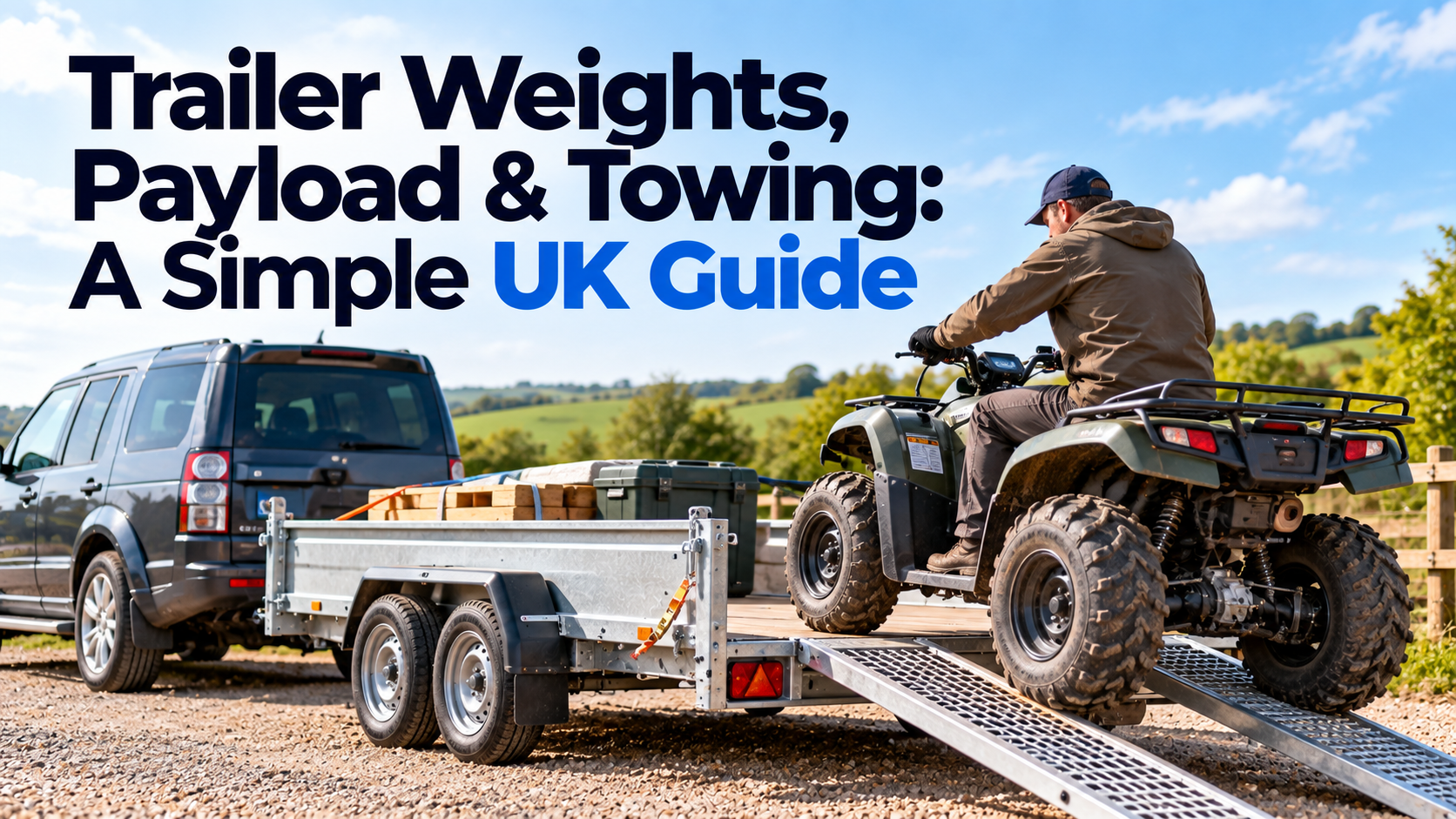
Trailer Weights, Payload & Towing: A Simple UK Guide
UK trailer weights in plain English — unladen weight, payload, gross weight, braked vs unbraked, and why your towing vehicle and driving licence entitlement matter just as much as the trailer.
Trailer weights confuse almost everyone buying their first trailer — and the advert rarely tells the whole story. This guide explains the key weight terms in plain English, how they fit together, and why the trailer is only one part of what you are allowed to tow.
A trailer's advertised weight is only part of the picture. You need to know what the trailer weighs empty, how much it is permitted to weigh when loaded, how much you actually need to carry, what your vehicle can tow and what your driving licence allows.
This is general practical advice, not legal advice. UK towing rules depend on your licence, vehicle and trailer, so always check current GOV.UK guidance for your situation.
Unladen weight
The unladen weight is how much the trailer weighs empty, with no load. It is the starting point for working out how much load it can carry.
Remember that accessories and equipment fitted to the trailer may affect its actual unladen weight, so do not assume the figure from an advert is exact.
Payload
Payload is the amount of load a trailer can carry within its permitted weight limits.
As a simple calculation, the trailer's MAM minus its unladen weight gives an indicative payload:
MAM − unladen weight = payload
However, axle limits and other restrictions can also affect the load you can legally carry.
Gross weight / maximum authorised mass
The gross weight is the maximum the trailer is allowed to weigh when fully loaded. On UK trailers this is commonly shown as the maximum authorised mass (MAM) on a plate fixed to the trailer.
This is the maximum permitted weight of the trailer and everything on it — not the amount of cargo it can carry.
How payload relates to the trailer's own weight
The gross weight is shared between the trailer itself and whatever you put on it.
Illustrative example: imagine a trailer has an unladen weight of 500kg and a maximum authorised mass of 2,000kg. The indicative payload would be 1,500kg (2,000 minus 500).
That is an illustrative example only — real figures vary. The point is that a "2,000kg" trailer does not carry 2,000kg. It carries 2,000kg minus its own weight, subject to any applicable axle or other limits.
Why the advertised payload matters
Sellers sometimes quote a headline "3.5t" trailer. That figure usually refers to the trailer's gross weight or MAM, not its payload.
If you need to carry 3,000kg of pallets, a 3,500kg trailer with a 900kg unladen weight would have an indicative payload of only 2,600kg.
Always check the trailer's weight plate and work out the likely payload from the MAM and unladen weight. Do not rely on the headline description alone.
Braked and unbraked trailers
Unbraked trailers have no brakes of their own and rely on the towing vehicle. In the UK, an unbraked trailer has a maximum authorised mass of 750kg, although the towing vehicle may have a lower limit.
Braked trailers have brakes that operate on the trailer. Overrun brakes are common on many trailers, while larger or specialist trailers may use other braking systems.
The braking type affects the trailer's permitted weight and what your towing vehicle and driving licence allow you to tow.
Why the towing vehicle matters
Your towing vehicle has a manufacturer-stated maximum towing limit — the maximum trailer weight it is designed to tow — and a maximum noseweight limit, which is the maximum downward load permitted on the tow ball.
Your vehicle will also have a gross train weight (GTW), where specified. This is the maximum permitted combined weight of the towing vehicle and trailer when both are loaded.
Check the vehicle handbook, manufacturer's information or the relevant vehicle data rather than relying on a seller's description.
A trailer that is within its own MAM can still exceed your vehicle's towing limit or the permitted combined weight.
Why the trailer's plated weight matters
The plate on the trailer states its permitted weight information, which may include the MAM and axle weights.
That information is important when assessing what the trailer can legally carry — not just the advert or the seller's description.
If the plate is missing, illegible or does not match the listing, treat the trailer with caution and ask the seller to explain the discrepancy.
Why the actual load matters
Even a trailer with a high payload is only legal and safe if the actual load stays within the applicable limits and is distributed sensibly.
Noseweight — the downward force exerted on the tow ball — must stay within the towing vehicle's permitted limit. Too much or too little noseweight can affect stability.
You should also consider the position of the load and any applicable axle weight limits.
Weighing the trailer and its load is the most reliable way to check the actual weight rather than relying on estimates.
Why all the towing limits matter
There is not one single number that determines whether you can tow a particular trailer.
You need to satisfy all the relevant limits, including:
- Your driving licence entitlement
- The towing vehicle's maximum towing weight
- The towing vehicle's gross train weight
- The trailer's MAM
- The trailer's axle weight limits
- The towing vehicle's maximum noseweight where applicable
The most restrictive applicable limit is the one that matters.
For example, a trailer with a MAM of 3,500kg cannot simply be towed at 3,500kg because the trailer is rated for that weight. If your vehicle is rated to tow only 2,000kg, you cannot use the full 3,500kg trailer capacity behind that vehicle.
Why driving licence entitlement matters
Your driving licence entitlement determines which vehicle and trailer combinations you are permitted to drive.
The rules depend on factors including when you passed your driving test and which categories are shown on your licence. The rules have changed over time, so do not rely on a single simplified rule.
Check your licence entitlement and the current GOV.UK guidance before buying a trailer.
For current information, see GOV.UK's guidance on towing with a car and driving licence categories.
Why you should check the trailer's plate and documentation
The advert tells you what the seller says; the trailer's plate and supporting documentation can help establish what the trailer actually is.
Check:
- MAM or gross weight
- Axle weights where shown
- Manufacturer and model information
- VIN or chassis number
- Any available documentation or receipts
- Whether the information matches the advert
A mismatch between the advert and the trailer is a question to ask before you travel.
For a full viewing checklist, see our used trailer inspection checklist.
Why you should not rely on the headline description alone
Adverts are simplified.
"3.5t braked twin-axle plant trailer" tells you the category and gives you an outline, but it does not tell you the real payload, axle weights, tyre size, hitch type or whether the trailer is suitable for your particular vehicle.
Treat the headline as a starting point, then check the weight plate, photos, specifications and seller information.
Before you buy
☐ Check the trailer's plated weights — MAM/gross weight and axle weights
☐ Check the trailer's unladen weight and work out the indicative payload
☐ Check the towing vehicle's maximum towing limit and noseweight limit
☐ Check the towing vehicle's gross train weight where applicable
☐ Check the relevant driving licence entitlement on GOV.UK
☐ Consider the actual load you intend to carry, and its weight
☐ Check the trailer's documentation and that it matches the advert
☐ Ask the seller if any weight information is unclear
Get those answers before you commit, and the rest of the purchase becomes much simpler.
When you know what you need, browse trailers for sale on UK Trailer Market and filter by category and weight to find the right match.